From Circuit Simulation to Traceable Reference Data: SpeedCircuits and openDAQ
SpeedCircuitsopenDAQintegration links ngspice circuit modeling, source provenance and evidence-aware reference-data workflows. This case study distinguishes predicted signals and software-qualified results from future physical measurements, without overstating an instrument validation.
Quick access
Public access to SC5 has not yet been verified.
The waveform that looked convincing—but was only a prediction
Students often encounter circuit simulators before ever connecting an oscilloscope. A simulated waveform looks precise: every curve has a color, a scale and a numerical value. But a beautiful graph answers only the question asked of its mathematical model.SpeedCircuits and openDAQgrew out of FermiLabs’ wish to connect that early excitement to a more rigorous practice: build a model, predict what should happen, collect reference evidence and eventually measure a real circuit without hiding the differences.
FermiLabs is a student-led Maker and Student Research and Development initiative. We build experiments that connect hands-on electronics,robotics,scientific computingand measurement, supported by accessibleArduinoplatforms and professionalDewesofttechnology. openDAQ offers a valuable common vocabulary for sources and signals in this ecosystem. The ambition is not to call every simulated value a measurement; it is to let students move progressively from theory to physical evidence while retaining the story of each data source.
What SpeedCircuits openDAQ workflows make accessible
SpeedCircuits uses browser-based modeling and thengspicecircuit simulator to make experiments approachable. A learner can change a resistor or capacitor, see the circuit description change, run a transient study or compare frequency responses. The software-qualified 2026 studies include guided Bode, transfer and noise analysis, where units, probe identity and numerical limitations matter. These aren’t decorations: if a noise plot silently changes from spectral density to integrated noise, the scientific meaning changes even though the image might still be attractive.
The physical-first educational concept goes beyond simulation. An Arduino board can serve as a familiar platform for learning how real sensors and analog inputs work; a Dewesoft instrument illustrates the higher standards expected of professional measurement; openDAQ can help future consumers recognize sources, units, domains and states across software boundaries. In the current accepted scope, the simulator and reference-data path are the demonstrated elements. We do not attribute a finished, calibrated Arduino acquisition run to the case study.
The difficult step: make comparison fair
Comparing predicted and observed waveforms sounds simple until their axes disagree. A simulation may assume exact component values and perfect source timing, while a physical circuit has tolerances, parasitic effects, finite bandwidth and instrument uncertainty. Even before a probe is attached, a student can list those unknowns. The next useful test will require pinning the circuit/netlist, solver version and analysis settings, then identifying the physical acquisition source, calibration and clock mapping before calculating any difference.
This is why the design uses explicit evidence classes. A simulated trace can be a useful benchmark for a later measurement or a software importer. It is not an independent observation of voltage across a component on a bench. Teaching that distinction builds confidence that students will know what their data demonstrates—and what it does not.
Case study · documented origin:SpeedCircuits was already a physical-first electronics learning project before its 0.4.1 software preview was published on 22 August 2026; the exact first development date is not established by that release record.Current story:software simulation and reference-data integration, not a claim of a completed calibrated physical Arduino/openDAQ experiment.
The question: where does prediction end and measurement begin?
A circuit simulation can predict a voltage waveform, while a Data Acquisition (DAQ) system can observe a physical voltage. Those quantities may be compared, but their provenance is not interchangeable. FermiLabs developed SpeedCircuits as a physical-first circuit-learning environment with magnetic construction elements and a browser-based simulator, then added bounded ngspice studies and an explicit evidence model compatible with its Arduino/openDAQ laboratory.
The larger Arduino–Dewesoft–openDAQ programme provides the instrumentation context: the goal is to join familiar embedded hardware and professional measurement workflows through common signal identities, units and traceable acquisition. A simulator result must remain visibly simulated until a real instrument produces a measurement.
How the software workflow is organized
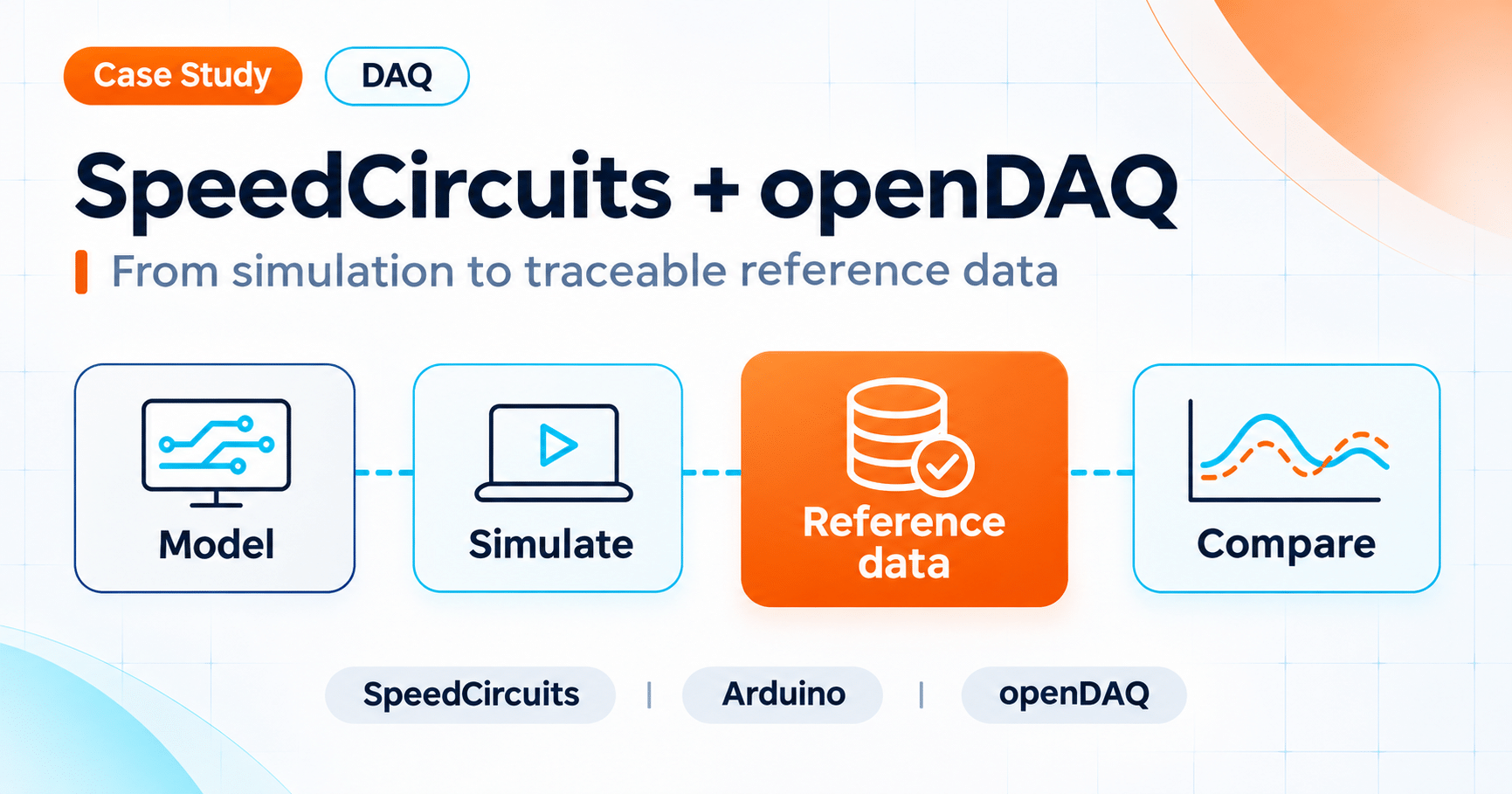
- Model:assemble a versioned circuit representation and choose known component values and sources.
- Simulate:run the pinned ngspice 47 WebAssembly solver in supported browser contexts, collecting transient or frequency-domain output.
- Inspect:run guided RC/Bode and resistive-divider Transfer/Noise studies with coherent axes, references and spectral units.
- Prepare evidence:retain solver version, run identity, circuit/netlist, chosen probes, units, parameter configuration and limits.
- Compare later:when physical measurement is available, bind real Arduino/openDAQ/Dewesoft signals to the same electrical question without relabeling simulation as acquisition.
History and changes
| When | Documented milestone |
|---|---|
| Before 22 August 2026 | Physical-first electronics kit concept and software development already underway; precise inception date requires earlier origin evidence. |
| 22 August 2026 | SpeedCircuits 0.4.1 preview presents 3D circuit modeling, ngspice simulation, DAQ-oriented workflow and optional Arduino/openDAQ paths. |
| 7 September 2026 | Software-qualified mobile/grid-first authoring and bounded R/C parameter and tolerance-corner studies are documented; physical mobile-touch testing is separate. |
| 8 September 2026 | Guided Bode, transfer-function and noise studies become source/software qualified, including invalid-axis and descriptor rejection; Audio Lab is qualified against pinned ngspice 47 WASM. |
| November 2026 | The existing public FermiLabs Engineering Update connects SpeedCircuits 0.5 and openDAQ 3.40.3 as an evidence story, not a new physical measurement certification. |
Results and engineering lessons
The technical value is the controlled path from a design hypothesis to repeatable software output and a prepared comparison contract. Bode and transfer-function visualizations are derived from solver outputs, not arbitrary curves. Noise reports must keep spectral density separate from integrated noise; a plot’s unit is a physical statement. Input-probe and reference changes invalidate derived values until the study is rerun.
Similarly, a software signal is useful reference material for testing DAQ tools, but it cannot prove sensor calibration, ADC accuracy, sample synchronization or real electromagnetic behavior. A future physical trial will need its own source, hardware setup, calibration, units, uncertainty, timestamp origin and test receipt.
What this study does not claim
- No simulated waveform is represented as a directly measured electrical trace.
- OptionalArduino UNO Q/ openDAQ provider paths are not automatically accepted physical measurement interfaces.
- The 0.5 software preview does not prove device safety, hardware tolerance or broad mobile hardware parity.
- The available UI drawings are explanatory, not screenshots of an accepted DAQ measurement.
Existing article and reproducibility sources
This expands, rather than duplicates, the existingSpeedCircuits 0.5 and openDAQ 3.40.3 Engineering Update. SeeSpeedCircuits projectandArduino OpenDAQ project. Detailed source, test and editorial records remain internal. Public background is available in the linked Project pages and from theofficial ngspice project.
Next experiment
Select a real defined-voltage test source and a documented Arduino/openDAQ/Dewesoft acquisition path, capture an authenticated signal record and compare it against the unchanged modeled output with explicit alignment, uncertainty and failure modes. Until that happens, this article remains a software/reference case study.
Partners, technologies and further reading
FermiLabs develops instrumentation and learning workflows withArduinoandDewesoftas technology partners, whileopenDAQprovides a common measurement and signal model where qualified. The architecture in this article is a scoped FermiLabs engineering report, not certification or endorsement of an unqualified integration.
Related FermiLabs material:SpeedCircuits project;SpeedCircuits 0.5 and openDAQ update;Arduino OpenDAQ project;Electronics foundation course. Cross-links to other unpublished case studies remain on hold until those articles are individually approved and public.
A classroom challenge: an RC circuit with two stories
Take a simple resistor-capacitor circuit. First estimate how quickly its capacitor should charge from the component values. Second, simulate the transient curve and note the assumptions in the netlist. Third, imagine testing the same circuit using an Arduino ADC or a Dewesoft instrument. What voltage range, input impedance, sampling rate and calibration would you need? Finally, design a table that keeps “predicted,” “simulated,” “reference recording” and “physically measured” in separate columns. The comparison is only trustworthy when those identities remain visible.
Partner-ready case study summary
FermiLabs developed SpeedCircuits to connect hands-on electronics learning with a disciplined model–simulate–measure–compare workflow. The browser-based environment uses a pinned ngspice engine and guided transient, Bode, transfer and noise studies, with explicit signal and source provenance. Its integration story with openDAQ focuses on a future-ready reference-data contract: simulation outputs can be organized and compared without being misrepresented as physical measurements. Arduino platforms provide an accessible learning path toward real acquisition, while Dewesoft measurement technology offers context for the rigor required in professional observation. The accepted 2026 evidence concerns software studies and reference workflows; no calibrated Arduino or Dewesoft hardware measurement is claimed for this case. The result is an educational method that helps students distinguish predictions, visualizations and experiments before attempting meaningful comparison.
Support a real model-to-measurement experiment
We would welcome lab support in the form of simple reference components, controlled signal sources, oscilloscope/DAQ access, professional input-uncertainty review and educational testing. Collaborators could help build a transparent sample lesson where the prediction and physical trace are both preserved. Learn more fromArduino,Dewesoft,openDAQand theSpeedCircuits project.