Running openDAQ 3.40.3 on Linux ARM64: From Installation to Native Reference Signals
openDAQ3.40.3onLinux ARM64gives FermiLabs a repeatable reference-device testbed before adding uncertain hardware variables. This case study explains installation, Native signal discovery, reference-domain metadata and exactly what the software-qualified checks established.
Quick access
The openDAQ Native reference device is a technical software environment, not a FermiLabs browser demo.
The little computer that needed to speak a professional DAQ language
The moment a measurement system moves from a developer’s laptop onto an embedded computer, dozens of assumptions become visible. Can the SDK be installed reproducibly? Are the compiled libraries actually for the target CPU? Will a client discover the device after a restart? Most importantly, if a sample arrives, can we prove which signal and time domain it belongs to? FermiLabs usedopenDAQ 3.40.3 on Linux ARM64to tackle these questions before risking a complex sensor experiment.
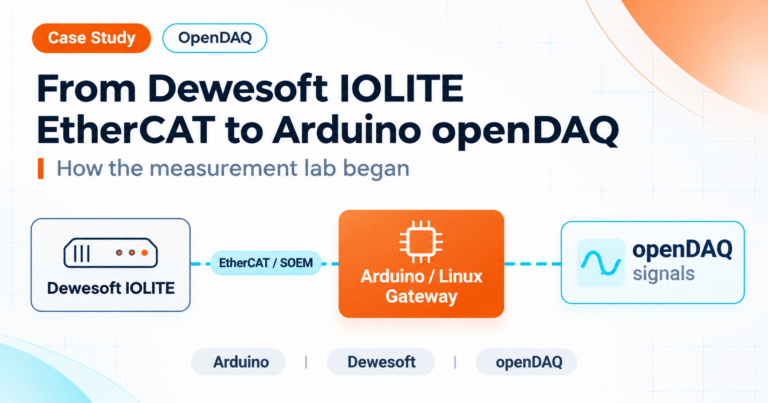
Our student-driven laboratory works withArduinoboards andDewesoftmeasurement technologies, using openDAQ when a common device-and-signal interface makes different tools easier to connect. The earlier journey—from a Dewesoft IOLITE/EtherCATgateway to Arduino GIGA Streaming LT and UNO Q experiments—showed why a repeatable Linux host foundation was useful. Instead of debugging board firmware, a Native client and a custom module all at once, we first built a verified host and a deterministic Reference Device.
Why openDAQ 3.40.3 on Linux ARM64 matters
A 64-bit ARM Linux system can serve as an edge computer: close to a machine or sensor, but powerful enough to run familiar software libraries. That makes it attractive for applications around Arduino systems with a Linux processor or a companion board. openDAQ offers an open-source SDK built around discoverable devices, configurable properties, signal descriptors, data readers and streaming. A team can implement a device without requiring every client to understand its unique acquisition implementation. TheopenDAQ projectthus provides the common language; Linux ARM64 provides the deployable computing environment.
The practical test was intentionally modest. We used two deterministic reference signals to confirm device startup, enumeration, signal descriptors and advancing time-domain values. Known mathematical samples can reveal software errors and timing interpretation faults, but they are not measurements taken from an analog input. That distinction is especially important when showing a visually convincing plot to students or prospective technology collaborators.
From install scripts to trustworthy evidence
Our accepted September 2026 sequence separated installation and ABI identity, service lifecycle, independent client connection and the observed reference data. We retained package/source identities and hashes so a later engineer could tell which binary actually ran. A reference-device test completed on both a Mac-operated development path and a distinct Debian/AArch64 host target within their stated boundaries. This was a foundation for additional experiments, not proof that a future EFBus or robot sensor was already connected.
That choice is valuable for openDAQ developers: an SDK becomes easier to adopt when qualification can be reproduced on the kind of edge computer a team actually owns. It is valuable for Arduino-based laboratories because embedded data can later be exposed through a service whose failure modes have already been studied. It is valuable to Dewesoft-oriented learners because using professionalDAQsoftware teaches that endpoint identity and data provenance matter before calibration or physical accuracy can even be discussed.
Case study · development context:earlierArduino UNO QopenDAQ 3.40.0 examples were already present by July 2026; the current 3.40.3 Linux ARM64 qualification was completed on 10 September 2026 and the focused install/start/open/verify MVP closed on 15 September 2026. This article covers the admitted host and Reference Device scope, not a calibrated physical sensor.
FermiLabs context:this laboratory connects Arduino embedded platforms with Dewesoft measurement workflows. openDAQ serves as an interoperability and signal-model layer where the specific integration is qualified. The wordssource-tested,host-qualified,board-measuredandreference-dataidentify different levels of evidence, not interchangeable claims.
Question: can the target be verified without a sensor attached?
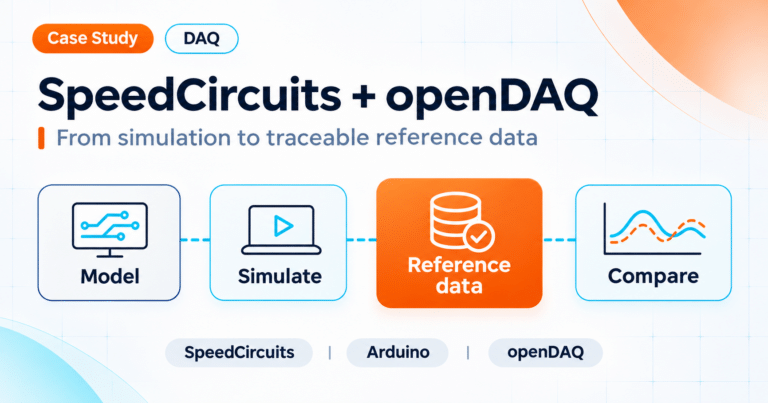
The purpose of the host milestone was to remove uncertainty about dependency installation, SDK ABI, Native lifecycle and client data semantics before adding MCU hardware or a custom acquisition device. A deterministic two-signal Reference Device is an excellent system test: it has a known source and can prove discovery, identity, metadata and increasing time-domain values without pretending to measure the outside world.
What we built
- An explicit openDAQ3.40.3Linux ARM64 GCC13 dependency baseline, with source/tag and package SHA-256 retained in the qualification receipt.
- A versioned install/self-check and clean-host lifecycle workflow instead of manual package copying.
- A reproducible Reference Device application with exactly two deterministic signals and stable signal identities.
- Native configuration/streaming inspection, direct endpoint open and independently checked domain progression.
- A reusable artifact policy: host SDK packages and later EFBus companion binaries can be consumed without a fresh board-by-board rebuild when their exact compatibility contract remains valid.
Timeline
| When | Engineering milestone / evidence |
|---|---|
| July 2026 | The UNO Q V06 technical package used a 3.40.0 Native-minimal SDK for its earlier gateway experiments. This is a historical baseline, not the 3.40.3 qualification. |
| 16 August 2026 | The consolidated Arduino-OpenDAQ repository already contained the UNO Q and GIGA histories and issues requiring accurate rate/source semantics. |
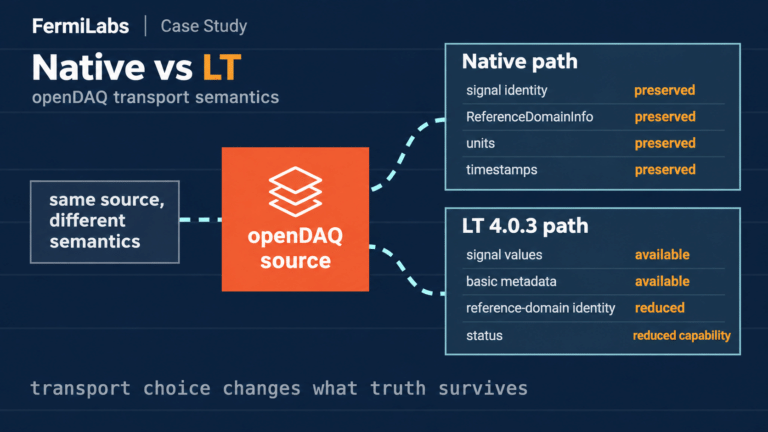
| 10 September 2026 | openDAQ 3.40.3 host qualification: exact Linux ARM64 GCC13 package, bounded SDK compile, Native lifecycle and reference-domain checks, plus LT 4.0.3 offline module loading. |
| 15 September 2026 | The MVP is accepted on the owner Mac and a separate Debian 13/AArch64 target: install → start → open → verify, two deterministic reference signals, bounded lifecycle and idempotence. |
| 3 November 2026 | A Mac/Docker Linux ARM64 build of the optional EFBus gateway/module/Indicators companions is retained as a reusable artifact, but installation and physical data admission are separate gates. |
Reproduction-oriented workflow
- Pin the exact SDK version and installation recipe; record the CPU architecture, OS, compiler and SHA-256.
- Install on a qualified Linux ARM64 host; run the documented self-check rather than assuming successful package extraction means a healthy runtime.
- Start the Reference Device application; verify its launch/service identity and ensure repeated start remains idempotent.
- From an independent client, open the Native configuration endpoint, enumerate the two distinct signal IDs and verify descriptors and increasing domain ticks.
- Record failures separately as installation, endpoint discovery, client negotiation or signal semantics instead of collapsing them into a generic connection failure.
Observed result and limits
The accepted MVP issue records Macinstall/start/open/verifyPASS and a separate ARM64 Debian target lifecycle acceptance. The target used a Native-only endpoint; the tests explicitly marked firmware, EFBus, MCU I/O, flashing, reset and physical output asNOT_RUN. The package identity must be rechecked against the current source if a materially different release is deployed.
The 3.40.3 host qualification also checked bounded MultiReader lifecycle, reconnect behavior, null tick-resolution handling and a 20-second liveness/RSS scope. None of those tests alone proves calibrated analog acquisition, deterministic Wi-Fi or a fully integrated robot gateway.
What comes next
A physically sourced EFBus/UNO Q or GIGA measurement can be added through a separately admitted producer path. When reference-domain facts matter, use the qualified Native policy and preserve source identity, units, epochs and clock uncertainty. A build/cached optional companion is not equivalent to that live physical integration.
Sources and related material
Qualification evidence for this experiment is retained in internal engineering records, not public repositories. Public reference:openDAQ — official upstream SDK. Related overview:Arduino OpenDAQ project.
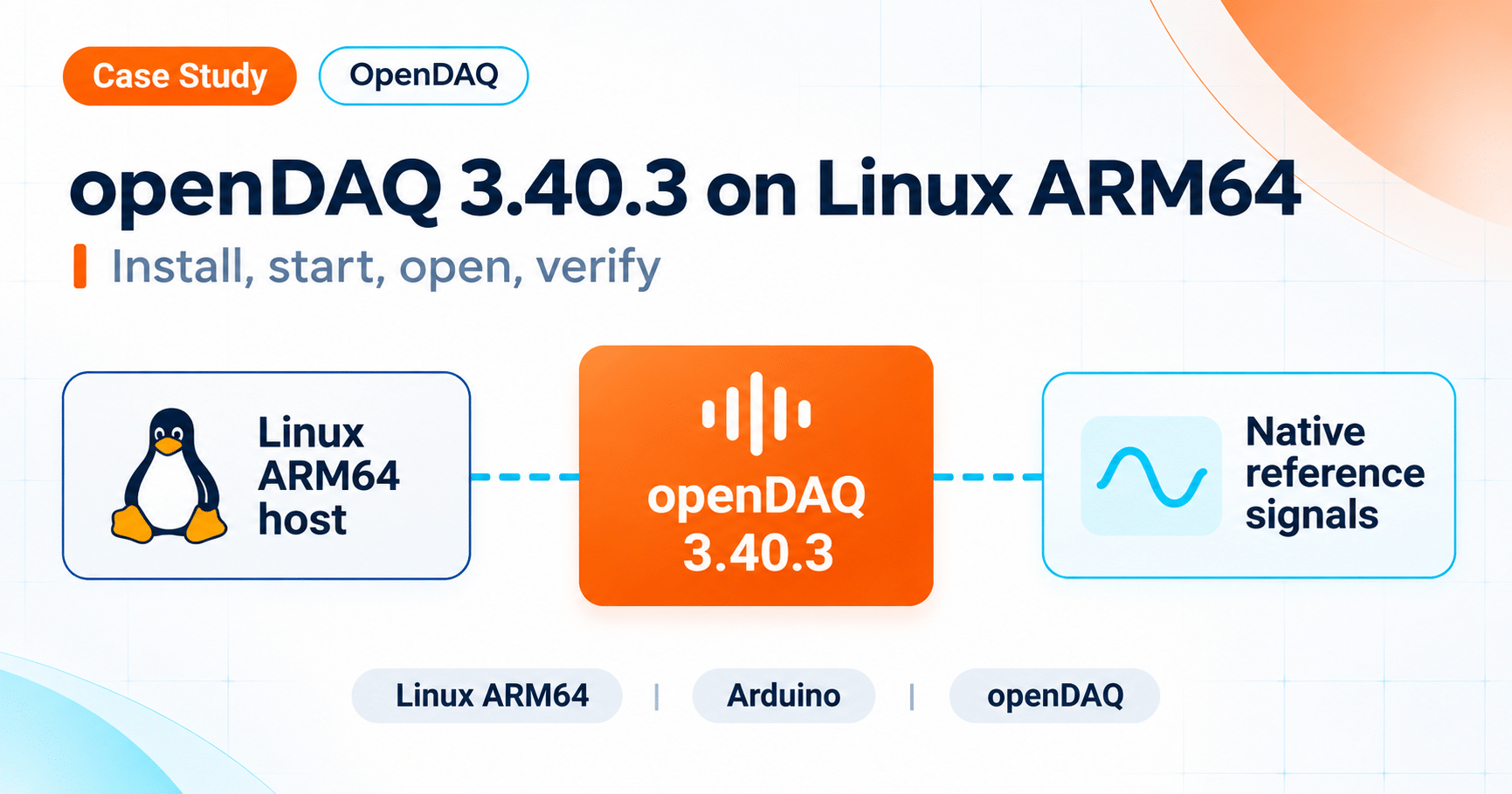
Media:use the existing illustrative ARM64 architecture diagram with a caption explicitly identifying its reference-signal values as schematic, not an authenticated client screenshot. Add actual client captures when a suitable privacy-clean recording is available.
Partners, technologies and further reading
This FermiLabs engineering case study is part of our work withArduinoandDewesoft, using theopenDAQdevice-and-signal framework where documented. Check each provider’s official resources for current product information. These scoped experiments do not imply manufacturer certification of the described integration.
Related FermiLabs reading:Arduino OpenDAQ project;Measurement and DAQ hub;UNO Q and GIGA update;Arduino Measurement and openDAQ course. Links to the other new case studies will be enabled individually as their articles become public, rather than linking to inaccessible drafts.
The classroom exercise: make your test falsifiable
A simple learning activity is to write down five questions before launching a reference stream: What exact SDK version is installed? Which host processor executes the service? What two signal IDs should appear? What units and clock/domain descriptions should each signal report? What constitutes a failed or stale read after reconnecting? Students should compare the expected answers with an independently captured client receipt, not mark PASS merely because a graph appears. This is a practical introduction to repeatable software validation.
Partner-ready case study summary
FermiLabs qualified an openDAQ 3.40.3 host workflow on Linux ARM64 to prepare a reusable data-acquisition software foundation for its Arduino and Dewesoft laboratory activities. The team pinned SDK/package identity, verified installation and service lifecycle, and exposed two deterministic Native reference signals for an independent client to inspect. The September 2026 host/MVP receipts describe accepted install, start, open and verification steps on admitted development and ARM64 targets. They deliberately exclude real MCU/EFBus acquisition, calibration and production deployment. This makes the work a useful educational case for openDAQ SDK adoption on embedded Linux: it isolates host compatibility and signal semantics before more demanding hardware is introduced. For Arduino users, it offers a future gateway pattern; for Dewesoft-oriented students, it illustrates why a believable trace requires version, channel and time-domain evidence.
Where industry and education can help
The next useful contribution is not a bigger claim but a better test: independent ARM64 host reproductions, hardware-timestamp analysis, client-compatibility feedback and owned screenshots from real devices. FermiLabs welcomes technical reviews and learning collaborations that help students go from a stable reference device to an honestly measured signal. For background, visit the officialArduinoandDewesoftsites and theMeasurement & DAQ programme.